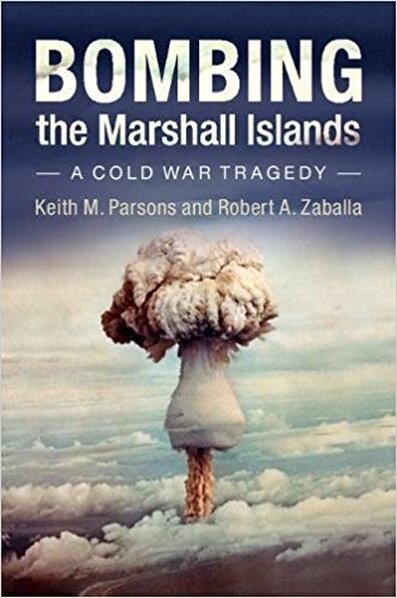
The average American possessing a basic knowledge of the history of nuclear weapons, at least to my anecdotal experience, believes nuclear weapons have been used twice since their creation, both times by the United States. The American military dropped the bomb on Hiroshima and Nagasaki, Japan, to end World War II, within days of each other, in August 1945. This history is factually incorrect.
It is quite true that nuclear weapons have been used only twice in war, but they have been detonated many times in testing, and the results have been devastating. Keith M. Parsons, a professor of philosophy, and Robert A. Zaballa, a nuclear physicist, have written a concise account of the remarkable yet tragic history of nuclear testing in the Marshall Islands of the Pacific. In “Bombing the Marshall Islands: Cold War Tragedy,” Parsons and Zaballa recount the fascinating events chronicling nuclear testing and the impact on those physically affected by the blasts. The authors’ descriptions of the blasts themselves are truly frightening. One of a series of tests was named Castle Bravo, which they describe as “a stupendous blast of 15 megatons – the equivalent of the simultaneous detonation of fifteen million tons of conventional high explosive. The fireball reached four miles in diameter and excavated a crater 250 feet deep and 6,500 feet across. The mushroom cloud rose to a height of over sixty miles in less than ten minutes. The power of the blast greatly exceeded expectations.” According to the authors, “During that time, the United States conducted sixty-seven nuclear tests on and in the vicinity of Bikini. The combined explosive yield of these events was 108 megatons – the equivalent of one Hiroshima-sized bomb detonated daily for nineteen years. As a result, some of these islands were grossly polluted with radioactive fallout and rendered uninhabitable… The beauty of basic physics is part of the story, but so are terror, suffering, and death.” One of the reasons this book is so valuable is in its inherent fairness. The authors do not take political sides on the issue. In fact, they take care to sympathize and state the arguments for both points of view. While the testing clearly had awful effects, Parsons and Zaballa clearly explain why the United States felt the urgent need to test during the Cold War period in order to assure the survival of the United States. They write, “One view was that these weapons were purely evil and their eradication was the only hope for humanity. The opposed view was that eradication was impossible, at least at that time, and that deterrence was the best way to avoid a nuclear catastrophe.” Describing their book as a “scholarly popular history” written for all, the authors write, “The lesson we draw is straightforward: When nuclear war is not only conceived as possible but is planned as a basic element of policy, the risks run during the period of nuclear testing are completely unsurprising.” One physicist recorded his observation of one test. “Suddenly there was an enormous flash of light, the brightest light I have ever seen or that I think anyone has ever seen. It blasted; it pounced; it bored its way right through you. It was a vision that was seen with more than the eye. It was seen to last forever.” The authors continue, “The initial flash may seem to last forever, but in a few seconds the explosion dims to the point where it is bearable by the human eye. The light resolves into a massive fireball, like a second sun, still intensely brilliant. Then it quickly transforms into a great column of fire, thrusting upwards at terrific speed and displaying a spectrum of terrific colors. The iconic mushroom cloud forms and rapidly rises, finally topping off miles into the atmosphere, far higher than any mountain. The devastating shockwave propagates rapidly outward from the hypocenter.” They quote a report as stating, “It is clear that the use of this weapon would bring about the destruction of innumerable human lives; it is not a weapon that can be used exclusively for the destruction of material installations of military or semi-military purposes. Its use therefore carries much farther than the atomic bomb itself the policy of exterminating civilian populations.” The authors continue, “Because the hydrogen bomb would have no inherent limits on its destructive capacity, such a weapon could only be used to devastate vast areas and kill huge numbers of civilians.” They conclude: “Therefore, a super bomb might become a weapon of genocide.” While residents of the islands were forced to evacuate for the testing, the authors chide the United States government for dispossessing people on the promise that humanity was being served without fully explaining the impact on their lives. Nevertheless and contrary to promises, residents almost certainly were never going to be able to return to their native lands, at least not as a safe locale. The effects are difficult to contemplate. Upon returning to one island, “…they found that all of their traditional foods had changed. One traditional food is the arrowroot, which is a starch similar to tapioca that is obtained from the rhizomes of a local plant. After exposure to the fallout, the arrowroot died or shrank in size, and burned the moth when consumed. Other foods had changed color, which made them appear unappetizing and maybe dangerous.” On birth defects, the authors state, “…the islanders suffered an unusually large number of miscarriages and births of children with severe defects. Some women gave birth to unformed fetuses that were not recognizably human, which midwives referred to as jellyfish babies.’” Horrible stuff. In addition to this remarkable history, the Appendices at the back of the book actually serve as terrific primers for physics in general. It was the first time, at an author’s recommendation, that I read an Appendix first in order to better understand a book. “Bombing the Marshall Islands” is a fascinating journey to a complex time in American and human history. This book deserves a wide readership as Parsons and Zaballa treat the subject with great knowledge and expertise, as well as sympathy and understanding. Let me cut to the chase. The Minnesota Vikings are the longest-suffering, most-suffering team in the history of the four major North American professional team sports. Vikings fans are the longest-suffering, most-suffering fans of any team in the history of the four major North American professional team sports. I always laugh when I hear of “long-suffering” Cubs or Red Sox fans (even before their championships in the last 20 years). If your team has won a world championship of any kind, no matter when, you simply cannot make the claim of “long-suffering,” at least as compared to Viking fans. As a lifelong New York City guy, I’ve been listening to fans of the New York Jets whining how they haven’t won a Super Bowl since 1968. But hey, at least they won one (the year before the Vikings first Super Bowl appearance). Certainly, there are other teams that have never won a world championship (San Diego Padres, Cincinnati Bengals, Buffalo Sabres, Phoenix Suns – just to name a team in each sport), but the Vikings are unique in that they have been very frequently and extraordinarily good – often great – in several different eras in their 61-year history. They are indeed the “greatest team to never win a championship.” It is inexplicable that they have never won. In fact, the oddities that have attended the Vikings are so unique and so defy all sorts of statistical odds, that one cannot be blamed for thinking some sort of paranormal karma affects them. The Minnesota Vikings have appeared in the playoffs 30 times in the Super Bowl era. Only the Pittsburgh Steelers and Dallas Cowboys have more playoff appearances in that period. So yes, the Vikings have been in the playoffs more times in the Super Bowl era than the New England Patriots, the San Francisco 49ers, and the Green Bay Packers (all multiple Super Bowl winners). By far, they have the most success of any team not to win a world championship. NFL on CBS made news recently, stating what we already know: the Vikings are the only team to have played in the NFL for 60-plus years without winning a championship. Also recently, Football Outsiders labeled the Vikings as “the greatest dynasty of heartbreak in the history of the NFL,” something Viking fans have known all along. Indeed, Viking fans are well-versed in the astonishingly bizarre events that have befallen the Vikings over the years. The fluke plays, the bad luck, the choking. But it’s more than that. Bad luck and bad bounces befall all teams. But the Vikings seems to have an inordinate amount of cosmic disaster in their DNA. I’ve heard every possible explanation as to why the Vikings have never won a Super Bowl, but strangely enough, I’ve never or rarely heard the reasons I will spell out here. After decades of media speculation and discussions with heartbroken fans, I have wondered why these things rarely if ever come up. From the outset, I want to point out that since the combination of bad luck and Viking fault cannot be exactly quantified down to the exact fraction of a percentage, I usually use the rule of thumb that it’s 50-50. Meaning 50 percent of the reason the Vikings haven’t won a Super Bowl is because of sheer bad luck, and 50 percent because of choking or downright player or coaching fault. I would add the caveat that the first Viking Super Bowl loss to the Kansas City Chiefs was somewhat before my time. I have heard that team was the greatest Viking team ever, that they were way better than the Chiefs, and that they should have won the game. Other than that, I offer no specific take on that game, except to acknowledge it was the start of a very haunting post-season history. The Vikings and their fans have endured countless moments of heartache. Some have been worse than others. Therefore, I will first mention two notable instances of Viking torture that are frequently referenced by fans. I do this in the interest of thoroughness because they happened in seasons the Vikings probably would not have won the Super Bowl anyway. Nevertheless, it’s certainly possible that they might have, if other things had broken their way. But for my purposes here, these incidents speak to the disastrous history of Viking heartbreak. 2003 – The greatest collapse in Vikings history. The Vikings began the season 6-0, lost the next four, stumbled to 9-6, and had to win the final game of the season to clinch the division. On the road, against a weak Arizona Cardinals team, the Vikings were eliminated from the playoffs on the final play of the game, a miracle fourth-and-25 pass from Josh McCown to Nathan Poole that went for a 28-yard touchdown. 2015 – The infamous Blair Walsh miss of a chip shot 27-yard field goal, with 26 seconds left, in a home Wild Card playoff game against the Seattle Seahawks that turned a certain win into a crushing playoff loss, preventing the Viking from advancing to the next round. I repeat, the two aforementioned games were as crushing as any of the many Vikings disasters, but I put them in a separate category because the Vikings probably would not have won the Super 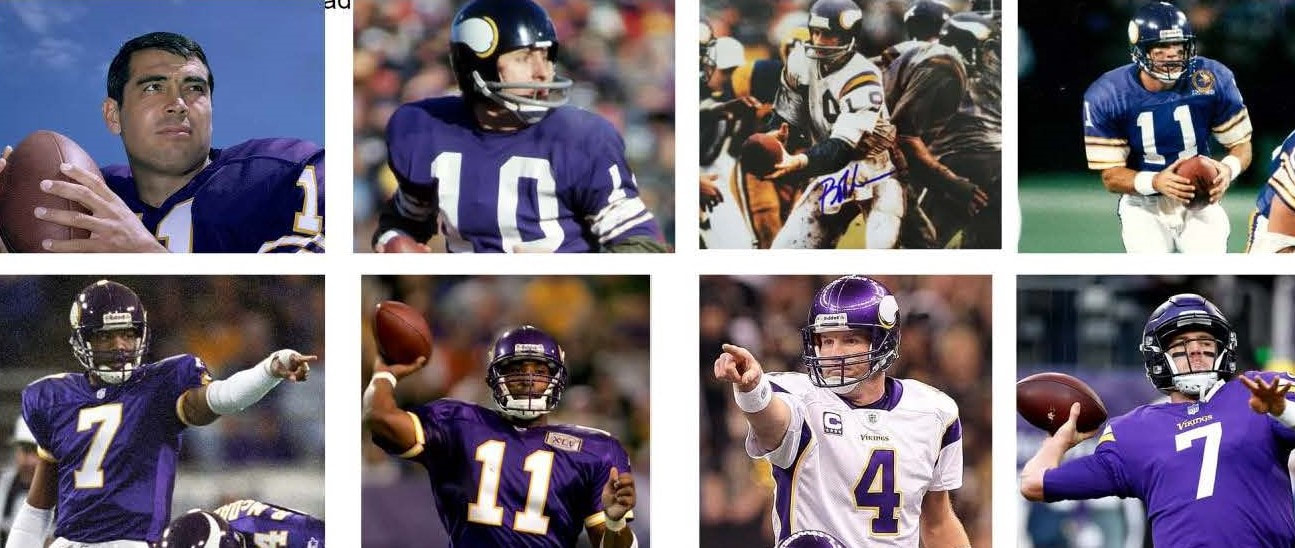 The eight Viking quarterbacks who have lost four Super Bowls and eight NFC Championship games: Joe Kapp, Fran Tarkenton, Bob Lee, Wade Wilson, Randall Cunningham, Daunte Culpepper, Brett Favre, and Case Keenum. Bowl even had they won those games and advanced. Now we get to the years the Vikings should have, or certainly could have, won the Super Bowl. The Vikings have very famously lost four Super Bowls. They appeared in four of the first eleven Super Bowls and lost them all. But what is less well-known outside of Viking fandom is that they have now lost six straight NFC championship games. Yes, think about this remarkable stat: the Vikings have made ten NFC championship games (I’m counting 1969, which was still technically the NFL championship game, before losing to the Chiefs in Super Bowl IV). They won the first four, and lost the next six. The latter is an NFL record, losing six straight conference championship games. The former was a Vikings record alone, until the Buffalo Bills tied them by losing all four of their Super Bowl appearances. It is almost a mathematical impossibility to reach ten conference championship games and never win a Super Bowl, but hey, these are the Vikings we’re talking about. Before getting to the top three reasons why the Vikings have never won the Super Bowl, I will focus on 1988, and then the “best of the rest” (to borrow from ESPN’s “Top Five Reasons…”) And remember, my point is not solely that there are reasons why the Vikings have never won the big one, but that there appears to be cosmic bad luck cursing the Vikings, as well as inexplicable odds-defying occurrences. And also remember that I place the “blame” 50-50, half on bad luck and half on choking. 1988 – This is the forgotten year when Viking historians talk about the team’s heartbreaks, and years in which the Vikings should have won the Super Bowl. Everyone talks about 1987 and the Darren Nelson “drop,” but 1988 is arguably the more painful year. The 1988 Vikings were probably the best team in football. Coming off the previous year’s near-miss, the Vikings entered the season as one of the favorites, certainly as championship timber. The Vikings and 49ers were both 5-3 when the Vikings headed to San Francisco for the crucial showdown on Halloween eve. This may very well be the one game in Viking history, more than any other, that has prevented the Vikings from winning the Super Bowl. The Vikings led 21-17 late in the game when the 49ers had third and short at the Minnesota 49 yard line. To this day, I cannot bring myself to watch the film of what happened next. The Vikings essentially had Steve Young sacked for a major loss. It would have been fourth down and forever and game over. How Young managed to escape the sack, or more accurately, how the Vikings managed to blow that play, are mysteries beyond the human mind. But Young not only escaped, he ran for a 49-yard touchdown with 1:58 remaining, giving the Niners the miracle win. There are a few things to say about what this result actually meant for the season. Had the Vikings won the game, they would almost certainly have had the number one seed and home field advantage throughout the playoffs. (In those days, there were three division winners, all of whom got byes, and two Wild Card teams who played each other). But it was more than that. The 49ers very likely would have missed the playoffs altogether. This is a crucial point because it was the 49ers who eventually eliminated the Vikings in the playoffs and who went on to win the Super Bowl. Imagine the difference – instead of having to play the Wild Card game and having no home games thereafter, the Vikings would have had home field throughout and no 49ers to face. Anyway, this was still not the end of the 1988 story. After this game, the 49ers lost the next two and finished 10-6, winning their division in a tie-breaker with the Rams. The Eagles, Giants, and Saints also finished 10-6 but missed the playoffs. The Vikings, on the other hand, won the next five in a row and still controlled their own destiny for the number one seed. At 10-4 with two games remaining, the Vikings headed to Green Bay to play the lowly 2-12 Packers. The Vikings were 11 point favorites. The Packers, who had already beaten the Vikings earlier in the year for one of their two wins, beat the Vikings 18-6, quarterbacked by someone named Randy Wright. It was the upset of the year, something Chris Doleman described as an “unexplainable mystery.” So, instead of having the best record, a bye, and home field throughout, the Vikings had to settle for a Wild Card with the conference’s second best record. Because of the ridiculous NFL rules, the Vikings were seeded behind both the 49ers and the Eagles even though they had the better record at 11-5. The Bears were the division winners at 12-4. So think about the two alternate universe scenarios: in one, the Vikings sack Steve Young, get the number one seed, and the 49ers miss the playoffs altogether. In the other, the 49ers are there, but the Vikings still have the number one seed (by beating Green Bay) and home field throughout. But of course, what we got was a Wild Card game win at home, then a thrashing on the road at San Francisco, playing a road playoff game even though the Vikings had the better record. “The Best of the Rest” – The Vikings have not had an elite, marquis, Hall of Fame quarterback since Fran Tarkenton. Again, I include this reason only for the sake of thoroughness. I don’t really think it belongs. But undoubtedly, someone will read this article and think I left out the obvious. So I just want to set the record straight. Yes, if they had had Joe Montana, Brett Favre, Aaron Rogers, Tom Brady, or Peyton Manning for full careers, the Vikings would have won a Super Bowl. But you can say that about any team. The point of this article is to point out that the Vikings should have won the Super Bowl with the rosters, the quarterbacks, and the teams they actually had. Reason #3 – Bad Matchups because of Bad Luck. This pertains to the Super Bowls the Vikings actually played in and lost. Again, because the first Super Bowl against the Chiefs is a bit before my time, I am focusing on the three games the Purple People Eaters played in the 1970’s with Frank Tarkenton at the helm. Let’s face it, matchups matter. I mean they really matter. Players, coaches, and team management never admit this. Drag out the cliché: “We don’t care who we play.” And, “It doesn’t matter who we play.” This is what they all say in sports. But the fact of the matter is that world championships in all of the major sports have been won because of favorable and lucky matchups. Teams have won championships because superior teams have been upset in earlier rounds. There are many examples, but I’ll name two here before getting to the Vikings. The New York Giants won a Super Bowl because the New Orleans Saints were upset by the Alex Smith 49ers. Drew Brees and the Saints had destroyed the Giants three times, scoring around 50 points each game. It would have been a horrible matchup for the Giants. I knew Giant fans who were practically dancing in the streets when they found out they were facing the Niners instead of the Saints. The Montreal Canadiens won a Stanley Cup when the legendary dynasty Edmonton Oilers were knocked out in an earlier round by the Calgary Flames in a massive upset. Montreal would have been lucky to win a game against Edmonton, yet won it all because the best team had been eliminated. It happens in all sports. Certainly, luck and chance happen in sports, and that doesn’t excuse the Vikings for not winning. I’m just saying that championships are not diminished years later when you look back and realize you had gotten a fortunate matchup. The Vikings Super Bowl teams were great. The 1973 team was 12-2; they were 10-4 in 1974; and 11-2-1 in 1976. But the Vikings had the misfortune of playing three of the greatest, most iconic, legendary dynasty teams of all-time: the 70’s versions of the Dolphins, Steelers, and Raiders. Only one game could even be called “competitive,” the Pittsburgh game, where the Vikings had the best matchup, and trailed by only three points in the fourth quarter. Still, it was almost as if the Vikings had no chance. The criticism of the Vikings here is not so much that they lost, but that they were just plain awful. In all four Super Bowls, the Vikings never held a lead and never scored a point in the first half. What I am saying is that the Vikings never had an “easy” game in the Super Bowl. They never had the good fortune of facing a team like, say, the 1985 Patriots, the 1994 Chargers, the 1995 Steelers, and my favorite example, the 1977 Craig Morton-led Broncos. After the Hail Mary game of 1975, I absolutely detested the Dallas Cowboys. I rooted against them for years. In 1977, when they were actually the best team in the NFC, they could have faced the defending champion powerhouse Oakland Raiders or the Pittsburgh Steelers. But when Denver upset the Raiders in the AFC championship, the Cowboys were gifted a walk of a matchup. When that same Cowboy team faced the Steelers in the Super Bowl (twice), they lost. Had any of those great Viking teams faced the Craig Morton Broncos, they would have won the big one. Reason #2 – Bad Luck because of Bad Luck. As I said, the Vikings are 50 percent to blame for their failures, but the strange things that have happened to the Vikings are legendary, and have bordered on the paranormal. 1975 – Many Vikings players and coach Bud Grant have said that the 1975 team was the greatest of all Vikings teams, greater than the teams that made the Super Bowl. The Hail Mary play is a cross that all Vikings fans bear. It is not only infamous in Vikings lore, it is one of the most well-known plays in NFL history. So a detailed rehash is not really necessary. There are two things, however, I do recall about that game that get far less attention. After the Vikings went ahead 14-10 with a touchdown, they had some real momentum and had finally taken over the game. They were again driving and faced a fourth and one in Cowboy territory. The way they were moving the ball, a first down was a real possibility. But the conservative coaching of Bud Grant opted for a punt, which did not even net them many more yards than a failed fourth down play. Then, on that horrific final drive, the Cowboys faced an “impossible” fourth and 17 in their own territory. No way do they get a first down. Roger Staubach’s throw to Drew Pearson on the sideline would have been caught out of bounds, but because of the old rules, when Nate Wright pushed Pearson out of bounds, the catch was ruled complete. That fourth and 17 conversion still gives nightmares. 1976 – The 1976 Super Bowl against the Raiders actually falls into Reason #2 as a bad matchup. But what had transpired in the previous two weeks was profoundly significant and impactful. The 13-1 Raiders were the best team in football. In those days, there were three division winners and one Wild Card team. The New England Patriots had gone 3-11 the year before and were an upstart team that came out of nowhere to grab the Wild Card with Steve Grogan at quarterback. The Raiders were prohibitive favorites in that opening playoff game. But for some odd reason, the Patriots seemed to have the Raiders’ number. They led 21-10 deep into the fourth quarter. There were no two-point conversions, so the Raiders needed two touchdowns. The game appeared to be over. Then on a desperate fourth-and-long, Ken Stabler threw an incompletion that appeared to seal the game. But a very questionable roughing the passer penalty was called on New England. It was not only questionable, but was one of those penalties that had no bearing on whether the pass would have been caught. Had Stabler been untouched, the pass would still have been incomplete. But the ensuing first down gave the Raiders life and a chance for a miracle. Indeed, they scored on that possession, got the ball back, and scored again with about 20 seconds left in the game. The point here is that had the miracle comeback not happened, the Vikings would have faced either the Steelers (in a much more winnable game) or those same Patriots. The Vikings matched up well with the Steelers and had beaten them in the regular season. Very likely the Vikings would have won the Super Bowl that year. Instead, they had no chance against the Raiders. 1987 – Yes, the Vikings made the NFC Championship game and everyone knows they lost because of the Darren Nelson “drop.” That’s not the whole story. First of all, with regard to the “drop,” there are two things. First, I always viewed it as a very tough play, and I never really blamed Darren Nelson with the defender all over him. Second, a catch would have only tied the game and sent it to overtime. But just as with the Hail Mary game, there are things that are little remembered about the game. With the score tied 7-7 early in the fourth quarter, the Vikings had an impressive drive going. They had first and goal at the four yard line. A touchdown was crucial. Alas, the Vikings had to settle for a field goal. That was deflating. The momentum shifted dramatically, as if Washington knew they had been given a new lease on life. I’ve always maintained that if the Vikings had scored the touchdown they would have won the game. And I am even more certain they would have beaten a mediocre Denver team that was essentially carried by John Elway in the 1980’s (when the Broncos were blown out in three Super Bowls). Having barely gotten past the Vikings, the Skins went on to a 42-10 Super Bowl win. 1998 – This game has been dissected more than any other in Viking history and many fans rank it right up there with the worst defeat of all. Besides the obvious (that the Vikings were 11-point favorites and should have wiped the floor with Atlanta, but instead played and coached a poor game) the thing that has always stood out to me about this game, is that six crazy things had to happen for the Vikings to lose the game. Not five out of six, but all six. 1. Taking a knee at the end of regulation. This is the only one that is debatable. There is, of course, no guarantee that the Vikings would have scored had they chosen to move the ball, but the conservative coaching of Dennis Green seemed to smack of a case of tight-throatedness and went against what had worked for the Vikings all year. 2. The Cunningham turnover just before the half. In what was looking like a Viking blowout at 20-7, the score could have been 23-7 or 27-7, or even only still 20-7, but was 20-14 and now a competitive game. 3. Randall Cunningham missing wide open Randy Moss for a sure touchdown. 4. Robert Smith inexplicably and continually running out of bounds at the end of the game. For the life of me, I have never understood the pointless stopping of the clock as the Vikings had the lead late in the game. 5. The Vikings defense allowing the game-tying touchdown with less than 30 seconds left. It was a disgraceful last stand, to say the least. And finally, everybody’s favorite. 6. The Gary Anderson missed chip shot that would have sealed the game, after not missing a kick all season. 2000 – I will cover this more thoroughly in Reason #1 below as it deals with blowing home field advantage, the main reason the Vikings did not get to the Super Bowl that year. 2009 – As with 2000, I will cover this in Reason #1, but even without the home field, the Vikings had this game in every way. The Adrian Peterson fumbles, the Brett Favre mindless pass after an MVP-type season, the criminal play of the Saints defense that the referees allowed. 2017 – Similar to 2000 in that the Vikings were blown out, but also in that the lack of home field advantage is what really cost the Vikings a trip to the Super Bowl. Reason #1 – Not Having Home Field Advantage. Players, coaches, management, sportswriters, media commentators, and even some fans seem reluctant to admit the overwhelming importance of home field advantage. Sure, everyone acknowledges that home field matters and you would rather have it than not have it, but just as world championships have been won because of favorable matchups, likewise championships have been won because of home field. I have always sensed a reluctance of people to admit that home field is almost always the “be all and end all.” Once again, drag out the stats. I know, the Giants, Steelers, and Packers have won Super Bowls after winning all road games in the playoffs. But those are exceptions. My point here is specific to the Vikings. Quite simply, the Vikings would have a few, or at least that unreachable one Super Bowl trophy, if they had had home field advantage in those NFC Championship games. If home field is not everything, it's practically everything. From 1980 to 1982, the Dallas Cowboys lost three straight NFC Championship games on the road (at Philadelphia, San Francisco, and Washington). After the third loss, Tom Landry was asked what the Cowboys had to do to get over the hump. Everyone was expecting this Hall of Fame legendary coach to give an X’s and O’s answer, or something personnel-related. Landry replied simply, “We have to get the game at home.” To repeat, the Vikings had made ten championship games; they won the first four and have lost the next six. Overall, they are 3-1 at home and 1-5 on the road. Of the first four they won (played by the Purple People Eaters), three were at home. Of the next six that they lost, five were on the road. They won on the road at Dallas in 1973 and lost at home to Atlanta in 1998. Other than those two games, home field advantage has been definitive. Especially regarding the last six losses, no serious observer believes the Vikings would have lost all six games had five been at home instead of only one. Only in 1977, with Bob Lee replacing the injured Fran Tarkenton, were the Vikings clearly the inferior team in the championship game. In the next five games, the Vikings were arguably the better team. They were point spread underdogs against the Redskins in 1987 and the Saints in 2009, solely because of the home field, and were actually favored on the road against the 2000 Giants and the 2017 Eagles. What I am saying is give the Vikings the home field advantage in those last four road losses, and they conservatively win at least two or three, and probably all four. So why have the Vikings had to play all those NFC Championship games on the road? As I argue, it’s a 50-50 thing, half being bad luck and half being the Vikings’ own fault. In 1987, the Vikings were plain unlucky. It was a season in which a strike forced the cancellation of only one game, so teams played 15 instead of 16. But three of those games were played with replacement players. The Vikings lost all three replacement player games. So while they finished 8-7, the real Viking team was 8-4. Washington, where the Vikings had to travel to play the championship game, was 11-4, but they had won all three of their replacement player games. So they were really 8-4, too. It is quite true that the Skins had beaten the Vikings in overtime at the end of the regular season, but the dynamic of that game might have been quite different if not for the skewed team records at the time. So the Vikings won magnificent road playoff games that year at New Orleans and San Francisco, but in the end it was asking too much to have to do it a third time (which they almost did). Plainly, I believe they win the game if it’s at home. Regarding home field in 1988, see the 1988 section above. In the 2000 NFC Championship game, everyone knows the Vikings were destroyed 41-0 at Giants Stadium. I have heard it argued that when you lose 41-0 it doesn’t matter where the game was played. At home, they would have lost by 30 instead, the argument goes. But that is so much baloney. Serious football observers know that the very dynamic of a football game is dramatically different from the opening kickoff depending on the home field. So it is short-sighted and foolish to argue the Vikings would have played so poorly and lost anyway if the game had been in Minnesota. Look, it happens every year with division rivals. How many times do you see the home team blow out the visitors, and then the second meeting is won by the other team when they are home? All the time, every year. Now, exactly how the Vikings blew home field advantage in 2000 is another painful memory that is (mostly) the Vikings’ own fault. The Vikings pretty much had home field wrapped up at 11-2 with three games to go. They had to win only one of the next two to clinch it. They were promptly blown out at St. Louis but were still seven-point favorites the next week at home against a Green Bay team that was out of the playoff picture. And once again, the Packers stuck it to the Vikings. There was no bad luck involved. In the most meaningful game of the year, in a game they were hugely favored to win, the Vikings simply stunk. Nevertheless, they still could have backed into the one seed with a little luck. And as everyone knows, backing in is just as good as winning outright. The Giants were playing a road game late in the year at Washington, with new Skins quarterback Jeff George (who had played for the Vikings the year before). Late in the game, the Giants were the beneficiaries of an awful call on replay. The Washington receiver appeared to catch the pass but it was ruled incomplete. One unremembered play in football history. But one that may have changed football history, too. If the catch is good, the Skins win the game, and the Vikings host the NFC Championship game instead of going on the road. Having to settle for the number two seed, the Vikings paid a very steep price. The 2009 Vikings are one of the great Viking teams ever, with Brett Favre leading them with an MVP-caliber season. Just as in 2000, the Vikings could have had the number one seed, had to settle for number two, so had to play the NFC Championship game on the road, and lost. In 2009, the New Orleans Saints gave another example of where being lucky was better than being good. To be sure, the Vikings deserve some of the blame here, but things unfolded as follows: the Vikings were having a spectacular year, starting 6-0 and standing at 10-1. Yet the Saints started the year 13-0. Since the Vikings' first loss, the Vikings were chasing the Saints all year for the one seed. During one stretch, the Saints were winning some very close games while the Vikings were blowing teams out. Some observers noted that the Vikings were arguably therefore the better team. Perhaps, but my take on it at the time was that as long as the Saints were holding on to the top seed, that was all that mattered because they would get the championship game at home. Well, as the Saints were losing the final three games of the season to finish 13-3, the Vikings could no longer win a road game, losing their last three on the road, two of them to bad teams, and costing themselves the home field advantage. The details of the “bad luck” aspect of the New Orleans game I explained above. And finally, 2017. For the third straight time the Vikings went to the NFC Championship game, they ended with the number two seed, which cost them a trip to the Super Bowl. 2017 was probably the one year where the Vikings were without fault in finishing number two. They seemed to be chasing the Eagles all year, but finished tied at 13-3, losing the tie-breaker. Similar to the Giant game in 2000, the Vikings were blown out, but I maintain they would have won the game if it was in Minnesota. Quarterback Carson Wentz was having a great year for the Eagles when he went down with a season-ending injury. At the time, it appeared to be a devastating loss. I remember asking four football fanatics (including one Eagles fan) what they would rather have, a healthy Carson Wentz and the number two seed, or Wentz out for the year with the number one seed. All four said a healthy Wentz. I told them all that they were wrong, that the home field mattered more. If you know Viking history, you would have gotten that. The only chance the Vikings had to be home for that game was if the Eagles had lost the first playoff game to Atlanta. They were underdogs at home, yet won the game. So I went into Sunday’s Vikings playoff game against the Saints with a sour attitude, knowing that even if they won, they would, once again, have to go on the road for the championship game. I was probably the only Viking fan in the world who was depressed after witnessing the Minneapolis Miracle, because I knew what was coming the following week. In 1977, following the fourth Super Bowl loss, sportswriter Jim Klobuchar wrote the book entitled, “Will the Vikings Ever Win the Super Bowl?” I hope I’m wrong, but deep down, I think we all know the answer to that. Frank Bella, a university professor, is a life-long New York City resident, and a life-long Minnesota Vikings fan. |